
The Same Behavior Can Have Different Reasons
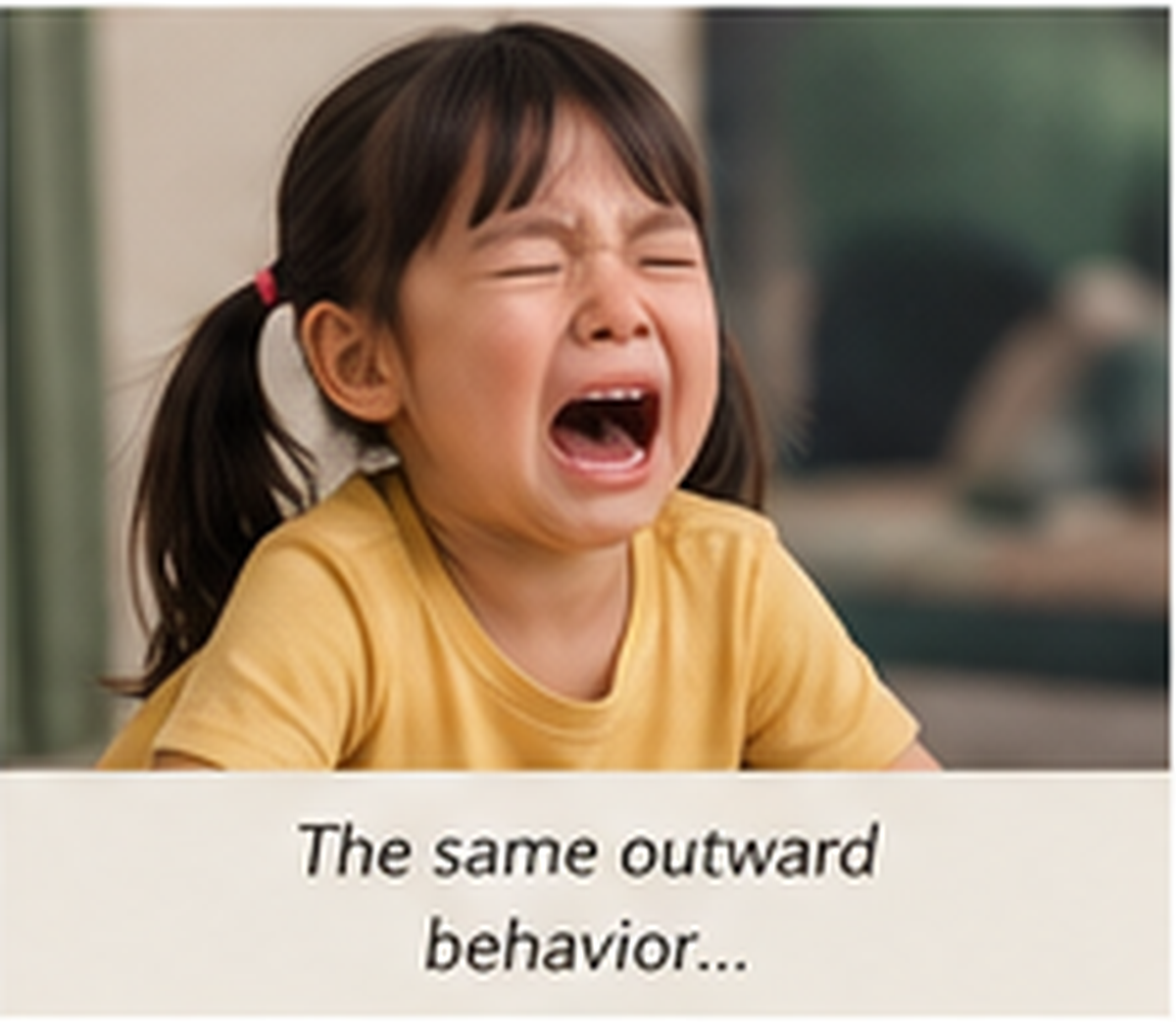
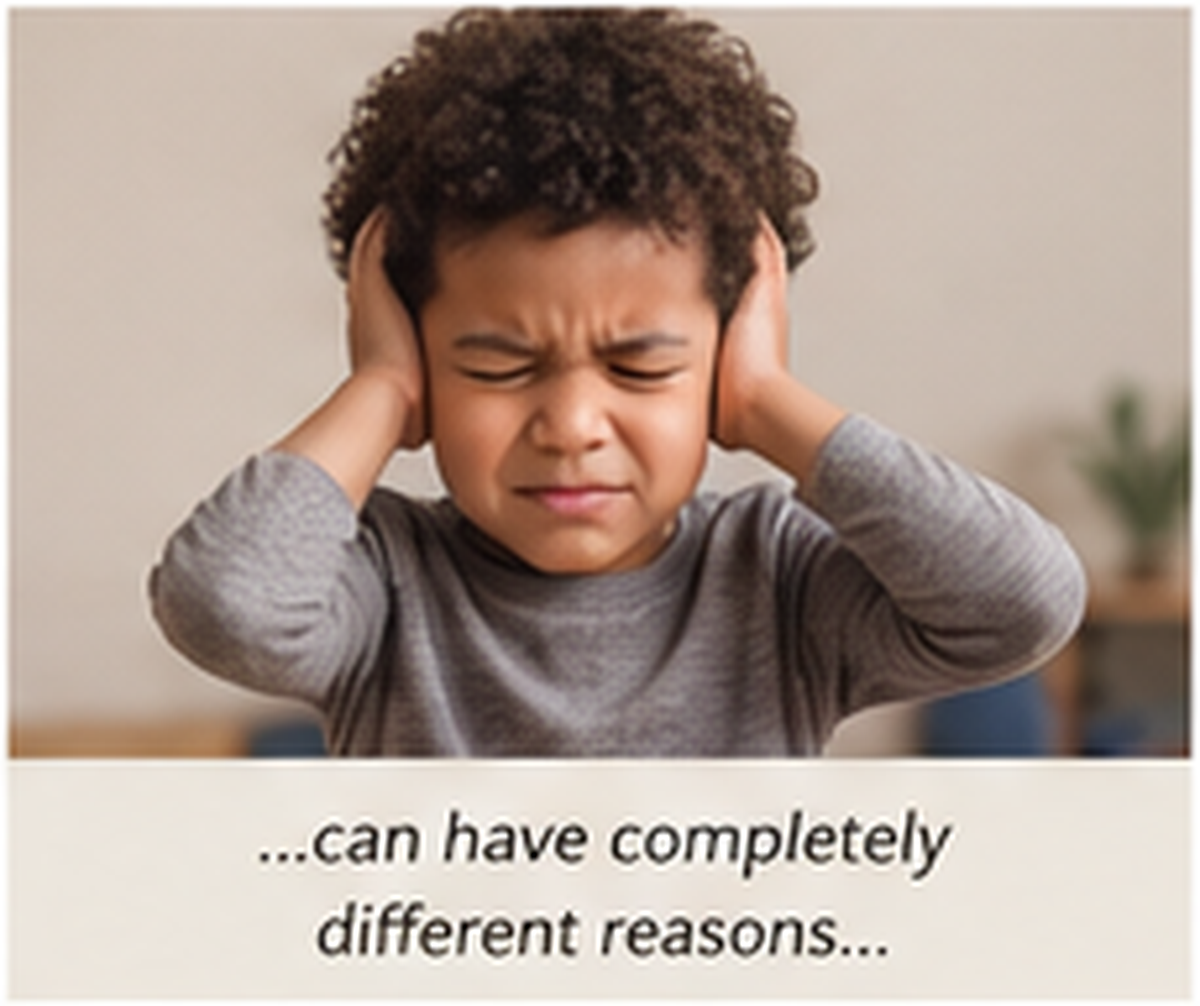
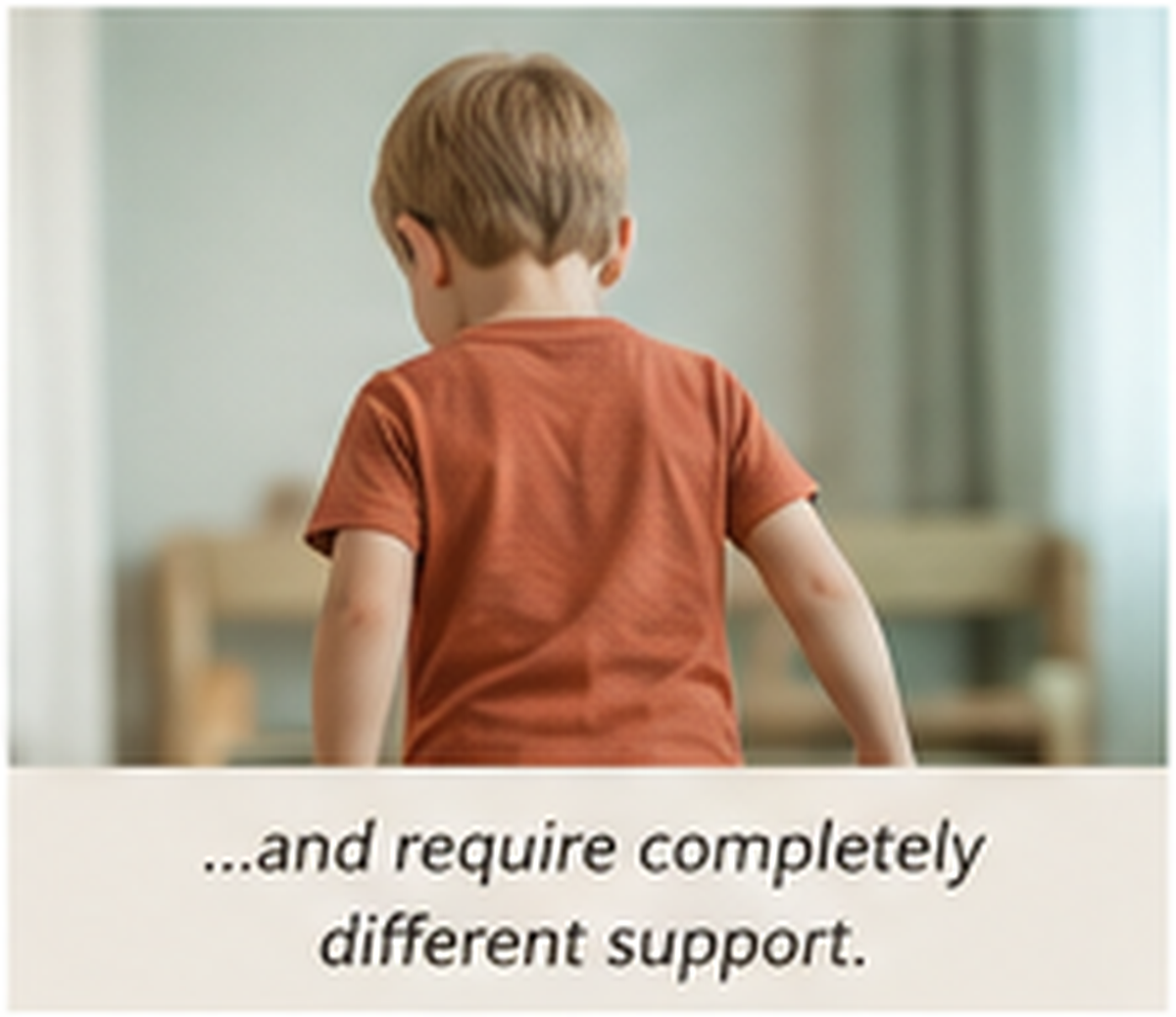
Two children can do the same thing for very different reasons. The same child can also do the same thing for different reasons on different days.
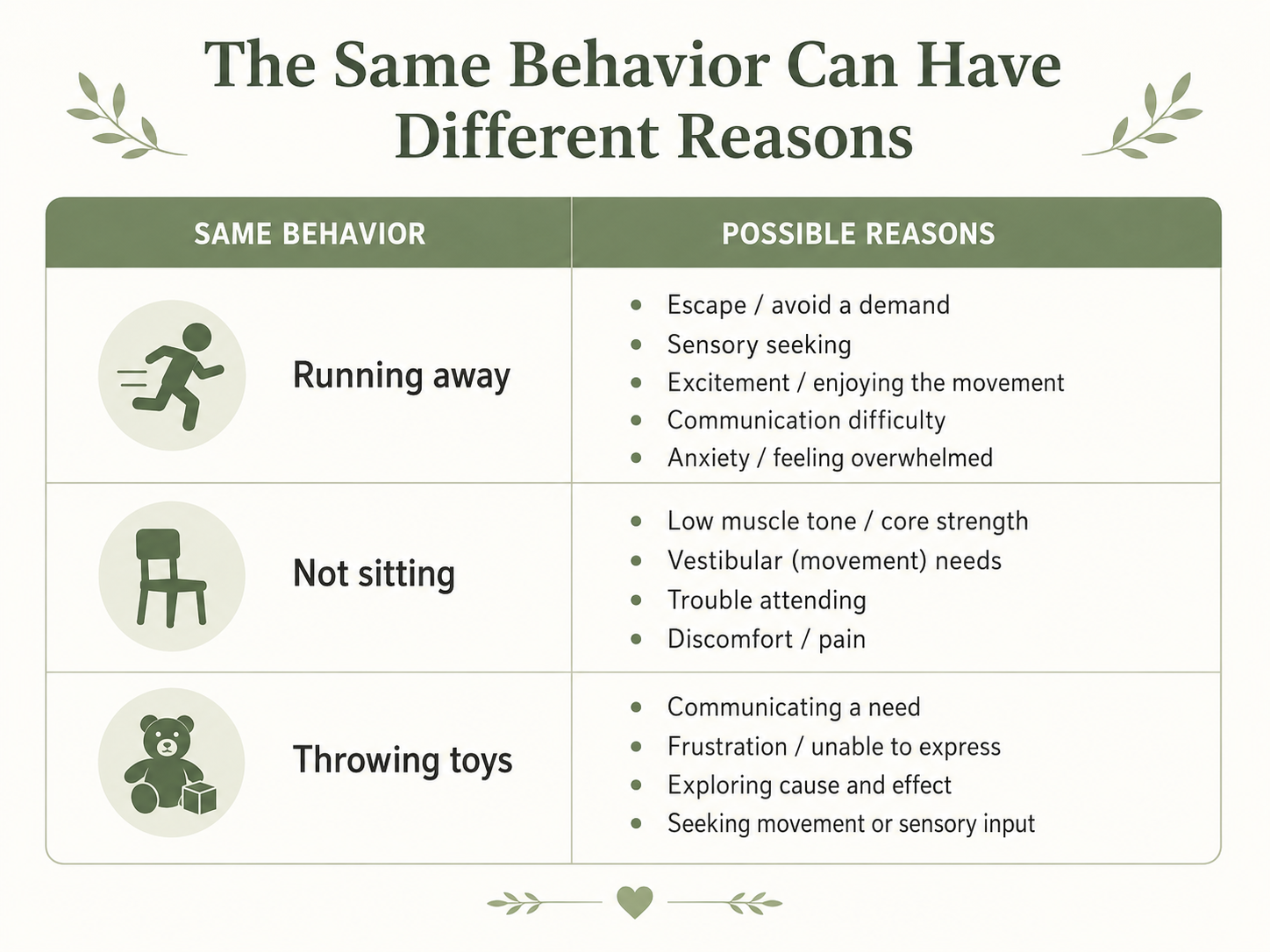
A child may leave an activity because it is difficult, because the next step is unclear, because the room is overwhelming, because leaving has repeatedly resulted in a pause, because the child does not have an effective way to ask for help, or because remaining in the activity requires more motor or regulatory organization than is currently available.
Sometimes several of these factors are operating together.
This is why the visible form of a behavior- running away, dropping, refusing, repeating, grabbing, pushing materials away- does not tell us enough to choose an intervention.
Description is not explanation
Words such as avoidant, rigid, inattentive, sensory seeking, noncompliant, or unmotivated can sound explanatory. Often, they are still descriptions filtered through an adult interpretation.
“He is avoiding the activity” tells us that the child is moving away from it. It does not yet tell us why moving away has become the child’s most effective response.
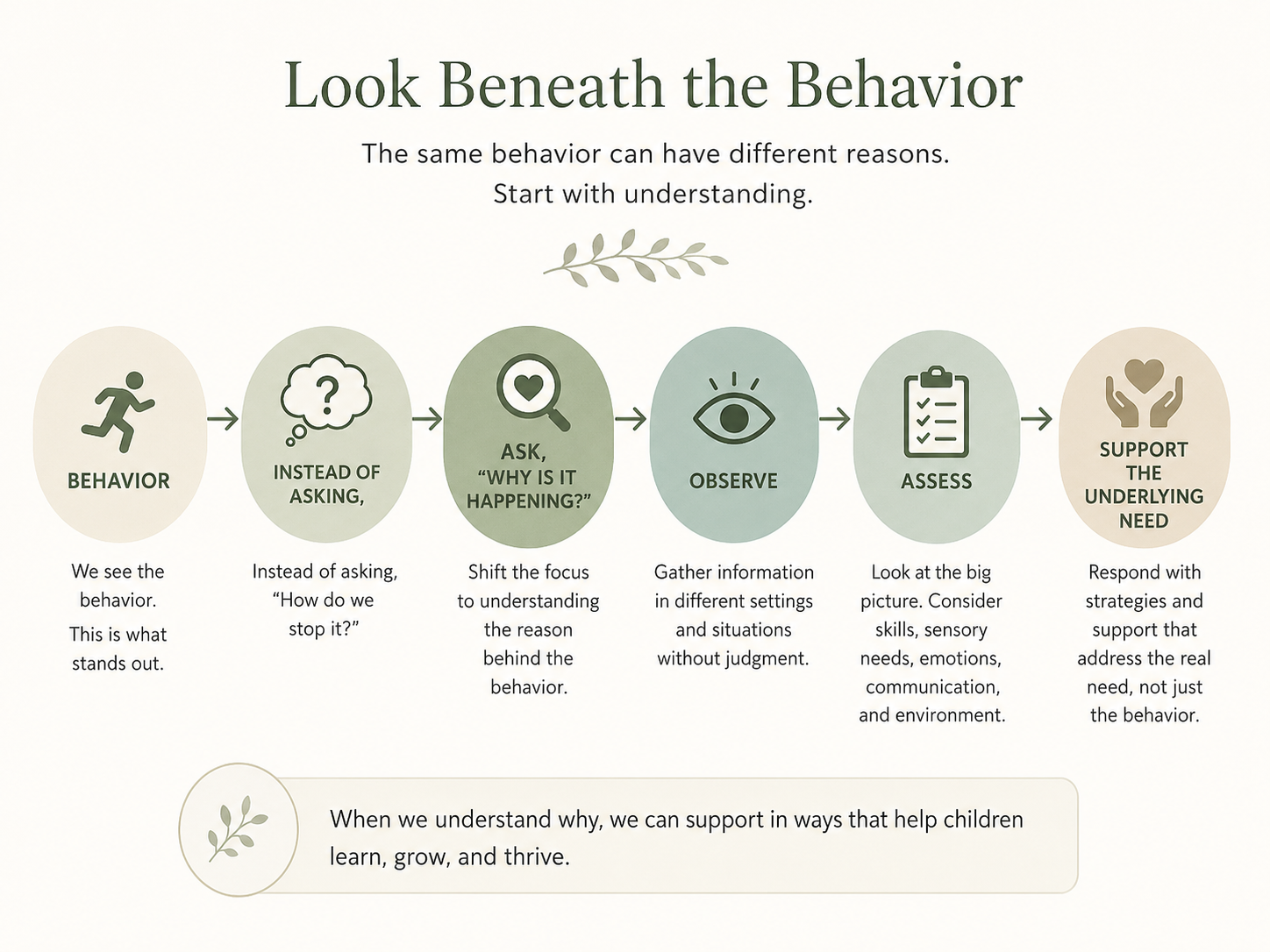
A useful assessment looks at what happens before, during, and after the difficulty. What changed? What did the child seem to gain, avoid, communicate, or make more manageable? This protects us from choosing support based only on what the behavior looks like.
What happens afterward matters, but it may not explain every condition that made the behavior likely in the first place.
What the behavior accomplishes matters-and so does context
Suppose leaving an activity consistently results in a break. The child may learn that leaving is an effective way to pause the activity. But we still need to understand what made the activity difficult to remain in.
Is the language too complex? Is the sequence unfamiliar? Does the child know the goal but not how to organize the action? Is the sensory experience uncomfortable? Is the child already tired, hungry, in pain, or overwhelmed? Has the child learned that leaving is faster and more reliable than asking for help?
These questions help us understand more than the immediate outcome.
The same is true when a behavior produces adult attention, access to an item, or a predictable sensory consequence. We still need to consider the child’s developmental abilities, communication system, physical state, learning history, and the specific demands of that moment.
Several pathways can lead to the same outward behavior
The task may be too difficult or too large
A child may understand the overall direction but be unable to hold all the steps, begin independently, or continue after making an error. Escape may be related to the amount or organization of the demand, not simply a dislike of work.
The child may not have an efficient communication response
If pushing materials away produces help more quickly than a gesture, word, picture, or device, pushing may become the more reliable communication method. Teaching communication requires more than prompting a phrase after distress has already escalated. The replacement response has to be accessible and effective in the actual situation.
The motor plan may be unclear
An activity can look easy to an adult while requiring the child to coordinate posture, imitation, sequencing, timing, and tool use. Waiting, wandering, or asking the adult to do it may reflect uncertainty about how to organize the action.
The sensory demands may be changing participation
Sound, touch, movement, visual complexity, proximity to others, or the internal sensation created by an activity may influence whether the child can remain available. “Sensory” should not become a catch-all explanation, but it should not be ignored when there is a consistent pattern.
The child may be trying to create predictability
Repeating a familiar action, insisting on the same sequence, or rejecting a change may make an uncertain situation more manageable. Adult responses can shape what happens next, while the repetition may also be serving an organizing role for the child.
A physical or medical factor may be contributing
A sudden or meaningful change deserves attention. Pain, illness, constipation, sleep disruption, medication changes, hunger, or other physical factors can alter participation and tolerance. An assumption that the problem is “just behavior” should not prevent appropriate medical consideration.
Do not choose the intervention from the label
If every refusal is treated as a motivation problem, adults may focus on making the reward larger without reducing the actual barrier.
If every movement is treated as sensory seeking, adults may add movement without determining whether it improves participation.
If every repeated action is treated as rigidity, adults may push flexibility before the child has enough predictability or communication to manage the change.
If every failure to respond is treated as inattention, adults may repeat the direction while the child remains unsure how to plan the response.
The better intervention depends on the better explanation.
That explanation should be treated as a hypothesis to test, not a story we become attached to.
Questions that sharpen the assessment
Parents and professionals can begin by asking:
• What exactly is the child doing?
• What reliably happens immediately before it?
• What changes immediately afterward?
• What task, sensory, motor, language, waiting, or social demands are present?
• Does the behavior occur with all activities or only particular kinds?
• Is the child able to request help, a break, more time, a change, or clarification in that moment?
• What happens when the task is made physically easier but the learning goal stays the same?
• What happens when predictability or visual information is added?
• Is this a longstanding pattern or a meaningful change from baseline?
• Are there possible health, pain, sleep, or medication factors that require follow-up?
The goal is not to create the longest possible list of explanations. It is to identify plausible variables, change one or a small number at a time, and observe what actually affects the behavior and participation.
A broader view still needs to be tested
Looking at development, sensory processing, motor planning, communication, and regulation does not mean assuming that every difficulty has an invisible neurological cause.
A broader approach still requires careful observation and a willingness to revise the explanation when the child’s response does not support it.
The difference is that we do not begin with the assumption that the visible behavior is the entire problem.
The larger point
Behavior gives us information, but it does not interpret itself.
The same action may help one child leave an overwhelming sensory situation, help another delay a difficult motor task, and help another obtain a predictable adult response. For one child, several of those outcomes may matter at once.
When we slow down long enough to ask what the child is trying to accomplish—and what is making participation difficult—we are more likely to teach a useful skill rather than simply suppress a signal.

Understanding the why behind the behavior helps us support the child-
not just change the behavior
Are familiar strategies failing to help? Book a free 15-minute consultation or contact Activate. Integrate. to discuss what you are seeing and whether a broader developmental, sensory, movement, and communication perspective may help.